
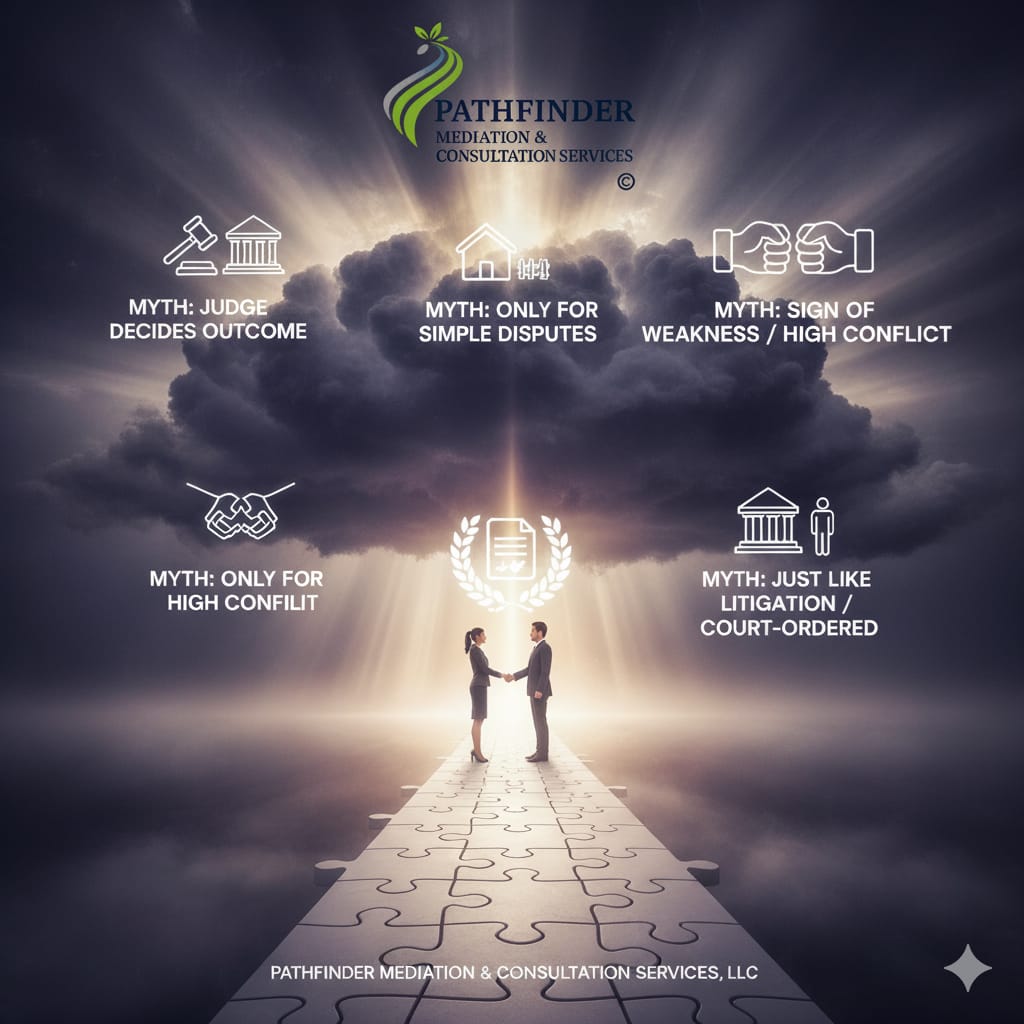
Busting the Biggest Mediation Myths: Your Guide to a Better Resolution
Mediation stands as one of the most effective, versatile, and often misunderstood forms of alternative dispute resolution (ADR). For those facing conflict, whether in a business setting, a family matter, or a neighborhood disagreement, mediation offers a voluntary, confidential, and empowering path to resolution. Yet, persistent myths and misconceptions continue to prevent many people from utilizing this valuable process.
It’s time to set the record straight and debunk the most common mediation myths, illuminating the true power and benefits of choosing this path over costly and time-consuming litigation.
Myth #1: The Mediator is a Judge Who Decides the Outcome
This is perhaps the most fundamental misunderstanding of the mediation process. Unlike a judge in litigation or an arbitrator in arbitration, a mediator does not possess the authority to issue a ruling, hand down a verdict, or impose a decision on the parties.
The Truth: A mediator is a neutral third party whose role is that of a facilitator. They guide the conversation, manage emotional tensions, ensure each party is heard, and help the participants explore creative, mutually acceptable solutions. The power of resolution—the authority to agree or disagree—rests entirely with the disputing parties themselves. In mediation, the participants write their own ending; the mediator simply helps them draft the script. This core distinction means the outcome is never dictated but rather designed by those who must live with the agreement.
Myth #2: Mediation is Only for Simple, Minor Disputes (e.g., Boundary Line Issues or Small Claims)
Many people associate mediation only with low-stakes, simple disagreements that seem too small for a courtroom. This belief drastically underestimates the process’s capacity.
The Truth: Mediation is an incredibly flexible tool used to resolve disputes of immense complexity and high financial stakes. Mediation is regularly employed in multi-million-dollar commercial disputes, complicated family estate conflicts, intricate construction defect cases, and even international policy disagreements. Its suitability for complex matters stems from its core advantages: confidentiality (protecting sensitive information from public record) and flexibility (allowing for customized, creative solutions that a judge, bound by law, cannot order). In fact, the more complex the dispute—the more parties, the higher the stakes, and the greater the need for a tailored solution—the more valuable the mediation process becomes.
Myth #3: Mediation is the Same as Arbitration or Litigation
While all three are forms of dispute resolution, the difference in process and control is vast. Treating them as interchangeable can lead to disappointment or a missed opportunity.
The Truth: Mediation is distinct because it is a collaborative and non-binding process (unless and until the parties sign a final settlement).
- Litigation involves a court, judges, lawyers, and public record, culminating in a binding decision imposed by a third party.
- Arbitration involves a neutral third party (the arbitrator) listening to evidence and imposing a binding or non-binding decision.
- Mediation involves the parties working together with the mediator’s assistance to negotiate their own outcome. This participant-driven nature is what allows agreements reached in mediation to be more durable and satisfying, as the parties feel ownership over the resolution.
Myth #4: Asking for Mediation is a Sign of Weakness or Means You Have to Compromise
This myth is rooted in the “win-lose” mentality of litigation, where entering into negotiation can be perceived as lacking confidence in one’s case.
The Truth: Choosing mediation is not a sign of weakness; it is a sign of strength, pragmatism, and business acumen. It demonstrates a commitment to resolving conflict efficiently and cost-effectively, rather than draining resources on a protracted court battle. Furthermore, effective mediation is not merely about “giving in” or splitting the difference. It focuses on identifying the underlying interests of each party—often revealing that what one party needs is not a concession, but simply information, an apology, or a specific performance guarantee. This focus on interests over rigid positions often leads to “win-win” solutions that no court could have provided, maximizing value for everyone involved.
Myth #5: Mediation Can’t Work if There is a History of High Conflict or Power Imbalance
Many high-conflict parties believe their relationship is too toxic, or their conflict too intense, for mediation to succeed.
The Truth: Trained professional mediators are specifically equipped to handle high-conflict scenarios and power imbalances. They employ sophisticated techniques, such as holding private meetings (caucuses), establishing strict ground rules, and controlling the flow of information and communication, to de-escalate tension. The goal is to create a safe, structured, and respectful environment where both parties can participate fully, regardless of their starting position. A skilled mediator acts as a crucial buffer, ensuring that aggressive tactics are contained and that vulnerable parties have their interests fully represented and their voice clearly heard, often leading to agreements even when trust is minimal.
Myth #6: Mediation Discussions Are Not Confidential and Can Be Used Against Me in Court
Fear of disclosure is a common deterrent, especially in disputes involving sensitive information.
The Truth: The mediation process is confidential and conducted on a “without prejudice” basis. With few statutory exceptions, what is discussed, admitted, or offered during mediation—including offers to settle—cannot be disclosed to a judge or used as evidence against a party if the case proceeds to litigation. This confidentiality is a cornerstone of the process, encouraging parties to be open, frank, and exploratory in their negotiations without fear that their vulnerability will be exploited later in court. This safe space for candid discussion is key to unlocking breakthrough agreements.
Myth #7: Mediation is Only for Court-Ordered Cases
While courts frequently mandate mediation before a trial date, the vast majority of successful mediations are initiated voluntarily.
The Truth: Mediation can be accessed at any time in a dispute—before a lawsuit is filed, while discovery is ongoing, or even during an appeal. It is a proactive conflict management tool. Whether it’s a business partnership dispute that needs to be settled before a costly lawsuit begins, or a family issue regarding elder care that requires a facilitated conversation, mediation can be the first step, not just the final court-ordered stop. The earlier parties commit to mediation, the more they can save in legal fees, emotional stress, and damaged relationships.
By dispelling these pervasive myths, individuals and organizations can recognize mediation for what it truly is: an empowering, flexible, confidential, and cost-effective path to generating sustainable solutions for virtually any conflict.
Ready to Find Your Path to Resolution?
If you’ve read through these common myths and feel a sense of clarity about the mediation process, your next step should be a proactive one. Every day that a conflict remains unresolved is another day of mounting stress, rising costs, and unnecessary tension.
Mediation offers a proven method for navigating disputes that preserves relationships, saves time and money, and puts the power of the solution firmly in your hands—not a judge’s.
Don’t let lingering misconceptions hold you back from finding a peaceful, durable resolution. The only way to know for sure if mediation is the right fit for your unique situation—whether it’s a high-stakes business disagreement, a family transition, or a workplace conflict—is to talk to a professional.
Take Control of Your Conflict Today.
The team at Pathfinder Mediation & Consultation Services, LLC is ready to help you explore how a facilitated, confidential conversation can be the path forward.
Book a free 30-minute consultation with Pathfinder Mediation & Consultation Services, LLC to learn how mediation could be the best, most practical route to resolving your dispute. Find out how you can stop preparing for a fight and start working toward a tailored solution.
Leave a Reply